

Futures are the most popular and the most dangerous tool in crypto. I ran five years of real prices to see how often leverage wipes out a position. The numbers below will make you want to close the x50 slider for good.
What a futures contract is
On a crypto exchange, "futures" usually means a perpetual contract. You don't buy the coin, you open a contract on its price movement. You can profit when price rises (long) or falls (short). And you can use leverage: open a position bigger than the money you have.
If you haven't traded spot yet, start there: spot trading for beginners.
Five terms you need to understand
Margin is your money that the exchange locks against the position. Collateral.
Leverage is how many times bigger the position is than the margin. $100 margin at x10 = a $1,000 position.
Liquidation is when the exchange force-closes your position because the loss has eaten the collateral. Your margin is gone. At x10 that's roughly a 10% move against you, in practice a bit sooner.
Funding is a payment between longs and shorts, usually every 8 hours (more often on some contracts). Hold a position for weeks and it noticeably hits your result.
Liquidation price is shown by the exchange before you enter. Always look at it.
Leverage amplifies both profit and loss. With $100 margin, a 5% move is ±$10 at x2 and ±$50 at x10. That's why pros don't think in leverage, they think in dollars at risk.
How often you get liquidated: our data
I took Binance daily candles from 27.11.2021 to 26.11.2026 and asked a simple question: you open a long on a random day and hold it 30 days with no stop-loss. How often does it get liquidated?
| Leverage | Liquidated at a move against you of | BTC | ETH | SOL |
|---|---|---|---|---|
| x5 | −20% | 16% | 27% | 41% |
| x10 | −10% | 41% | 58% | 66% |
| x20 | −5% | 67% | 75% | 82% |
A 10x Bitcoin long, opened and forgotten for a month, burns in 4 out of 10 cases. On SOL, 2 out of 3. Even x3 on SOL gets liquidated 18% of the time.
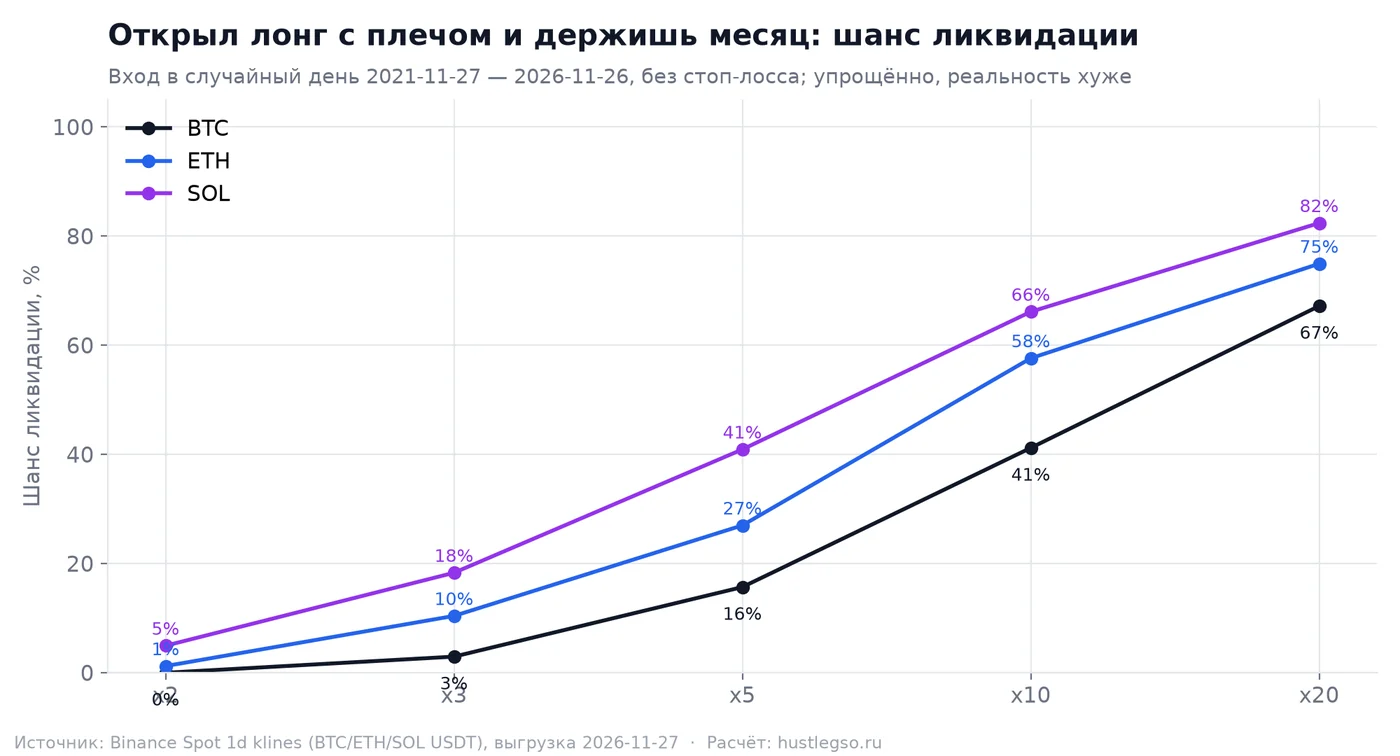
Reality is worse than these numbers. The model is simplified in the trader's favor: spot prices instead of mark price, no maintenance margin, no fees, no funding. On a real exchange you get liquidated earlier. This is historical data, not a forecast.
x50 is a lottery ticket
At x50, a 2% move against you liquidates the position. I checked: a 50x long opened at the start of the day (00:00 UTC), on what share of days over five years would it burn before the day ends?
| Coin | 50x long liquidated the same day |
|---|---|
| BTC | 35% of days |
| ETH | 47% of days |
| SOL | 60% of days |
On Bitcoin that's every third day, and shorts fare about the same (34%). For comparison, a 10x BTC long burned within the day on 1% of days. That isn't trading, it's betting on a quiet day.
Why crypto swings so much
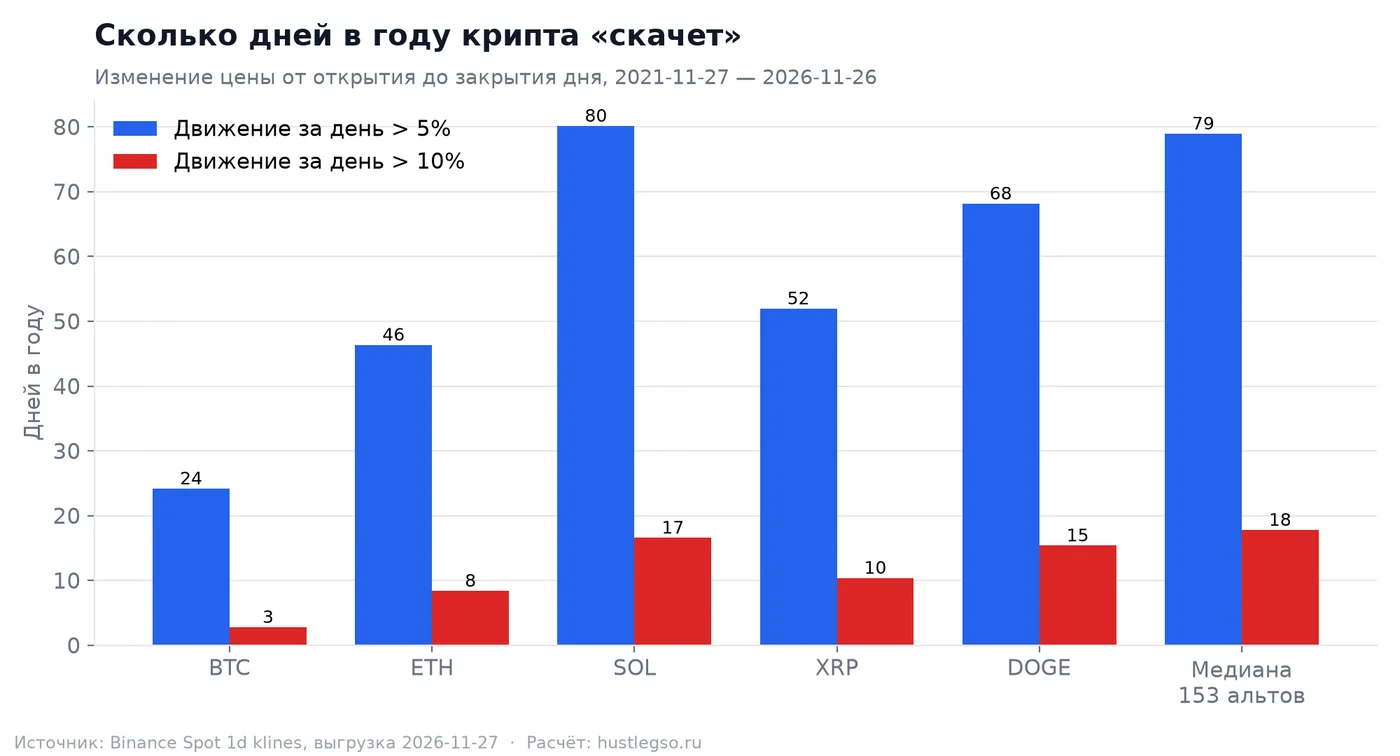
Bitcoin moves more than 5% in a day (from the day's open to its close) on roughly 24 days a year. The typical altcoin (153 that traded the whole period) does it on 79 days a year, around 18 of which are moves above 10%. Worst day in five years: BTC −15.4% (13.06.2022), SOL −42.2% (09.11.2022, the FTX collapse).
In crypto, days like that are normal. Any leveraged position has to survive them, and at x20 it won't.
Isolated vs cross margin
When you open a position, the exchange asks for the margin mode.
- Isolated: only that position's margin is at stake. If it gets liquidated, that margin is lost and the rest of your account is fine. But only if auto-margin (Auto-Add Margin) is off. Otherwise the exchange tops it up from your free balance.
- Cross: your entire futures balance backs the position. Liquidation sits further away, but when it hits, it can take everything in the account.
Cross feels safer because liquidation is far. In reality the loss just runs longer, all the way to your whole deposit. On a unified trading account, other coins in your balance can end up backing cross positions too.
How to set up futures safely
- Move only your trading money to the futures (or unified trading) account.
- In the order form, choose isolated margin.
- Turn off auto-add margin if it exists.
- Set leverage no higher than x3–x5.
- Size the position from your stop (formula in stop-loss and position sizing), not from leverage.
- Enable TP/SL right in the order form so the stop and target are set at entry.
- Check that the liquidation price is further away than your stop. If it's closer, lower the leverage.
- After opening, check the Positions tab and confirm the stop and target are there.
Exchange interfaces change and button names differ, but the logic is the same.
Funding: the quiet cost
When the contract trades above spot, longs usually pay shorts; below spot, the reverse. A single payment looks tiny, but held for weeks with leverage it eats into your result. The current funding rate is shown on the contract page. Check it before entering if you plan to hold.
Futures stop list
- Never open a trade without a stop. Not even "for a minute".
- No x20+ and no cross margin. x20 on BTC held a month without a stop burns 2 times out of 3.
- Never average down a losing position. Adding against yourself with leverage is the road to liquidation.
- Don't trade small caps with leverage. They move 10%+ on about 18 days a year.
- Never trade money you need: loans, rent, your emergency fund.
Can you trade futures "safely"?
Safely, no. You can cap the loss: 1% account risk per trade, stop at entry, isolated margin, leverage up to x5 and a daily loss limit. That keeps you in the game, but it doesn't create profit. Profit is only possible if your journal, over hundreds of trades, shows an edge after fees.
What's next
I share new research on leverage and market volatility in my Telegram channel. If you already trade futures and want a second pair of eyes on your risk rules, apply for 1:1 mentorship.