

DCA means buying a fixed amount on a schedule, with no attempt to time the market. I ran it against three "smarter" rules over five years of data, and the most boring strategy won.
What DCA is
DCA (dollar-cost averaging) means you buy an asset for the same amount at regular intervals: every week, or every month after payday. When the price is high you get fewer coins, when it's low you get more. Your average entry price evens out on its own.
The point of DCA isn't the return. It's that it removes the question "when should I buy?" The answer is always, on schedule.
The experiment: 5 years, one budget, 4 strategies
Setup: $100 a week for 261 weeks (27.11.2021–26.11.2026), $26,100 invested in total. Prices are Binance BTCUSDT daily closes; market sentiment is the alternative.me Fear & Greed Index. Data pulled 27.11.2026.
| Strategy | Final value | Return |
|---|---|---|
| Everything on day one | $28,893 | +11% |
| DCA $100 every week | $36,876 | +41% |
| Save up and buy only on "extreme fear" (<25), 83 buys | $30,583 | +17% |
| Buy only on "greed" (>75), 29 buys | $25,820 | −1% |
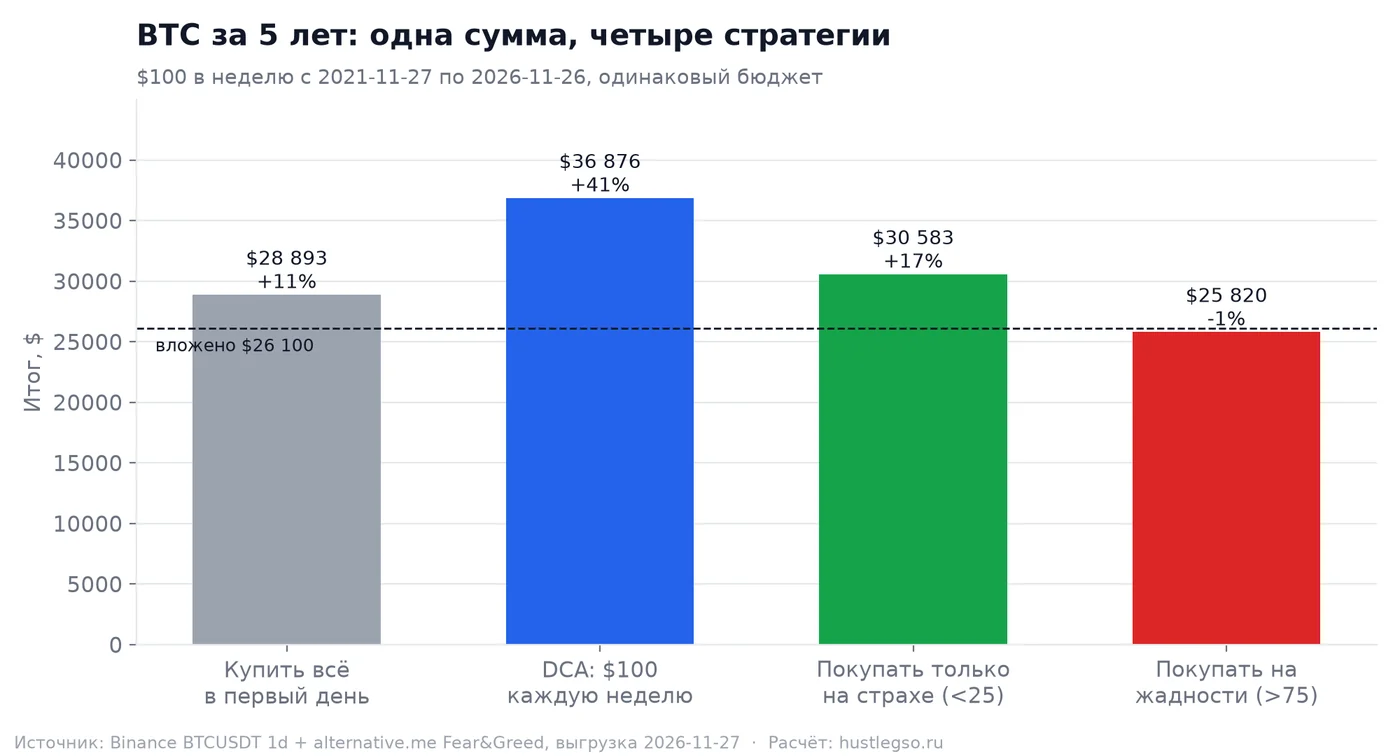
"Wait for fear" made +17%: the cash sat idle for weeks while the market rose. Buying on greed was the worst of all. Going all in on day one made +11%, because the entry landed almost at the 2021 top.
An honest note on the comparison. "All at once" assumes you had $26,100 on day one; DCA assumes money arrives at $100 a week. Those are different life situations. At the time of the study BTC is 52% below its all-time high, so the market is in a downturn. This is historical data, not a forecast.
But the time window decides everything
The same calculation over other periods gives a different picture:
| Strategy | 3 years | 5 years | Since 2018 |
|---|---|---|---|
| All at once | +63% | +11% | +557% |
| Weekly DCA | −18% | +41% | +269% |
| Fear only | −18% | +17% | +209% |
| Greed only | −23% | −1% | +191% |
If you happened to buy at the bottom, a lump sum wins by a mile. If you bought at the top, it loses. Nobody knows which one it is in advance.
DCA doesn't give you the maximum. It protects you from the worst entry. And one thing holds across every window: buying on greed comes last.
The Fear & Greed Index: does "buy when others are fearful" work?
The index is a number from 0 to 100 built from volatility, volume, social media and BTC dominance. 0 is panic, 100 is euphoria. You can check it here: hustlegso.ru/go/feargreed.
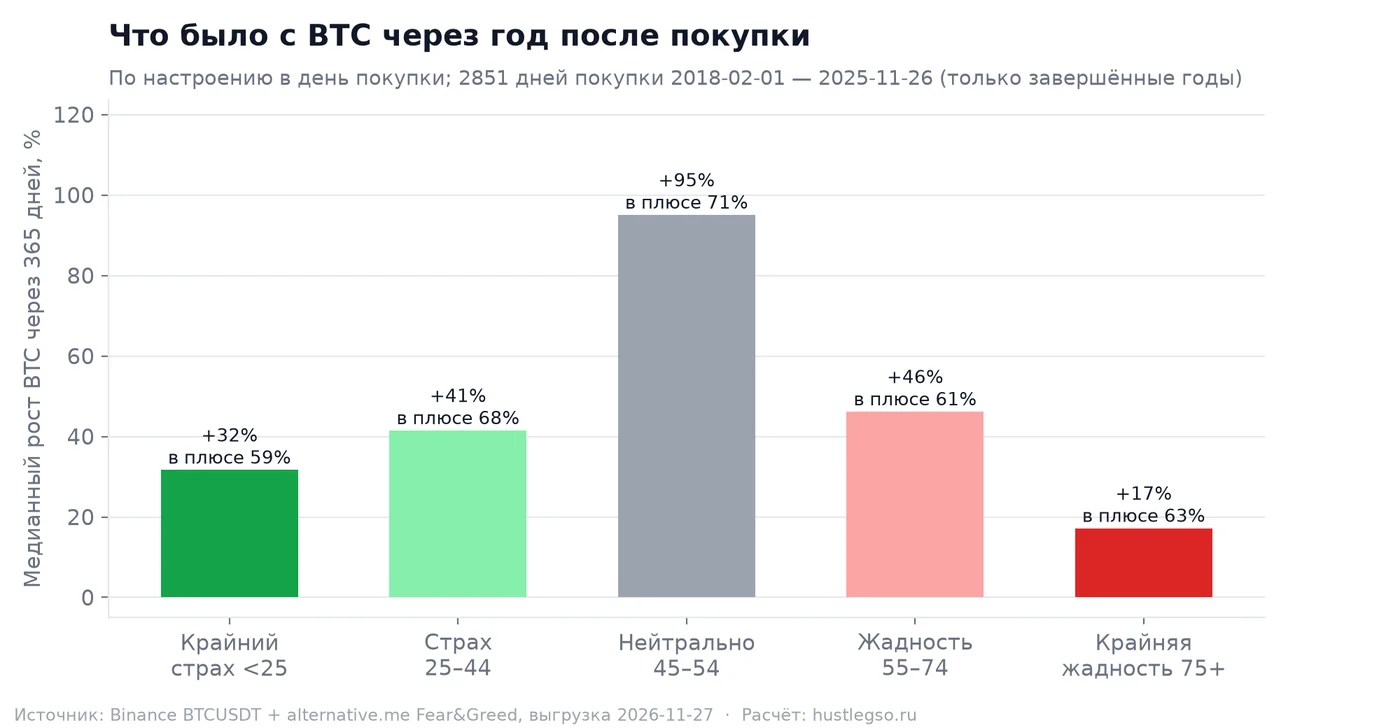
What BTC did one year after purchase (median, only purchases with a completed year, 02.2018–11.2025):
| Sentiment on purchase day | After 365 days | In profit |
|---|---|---|
| Extreme fear | +32% | 59% of cases |
| Neutral | +95% | 71% |
| Extreme greed | +17% | 63% |
Neighboring days nearly repeat each other, so treat this as an observation, not thousands of independent experiments. The takeaway: the index isn't a "buy" button. Extreme fear covered 22% of all days since 2018.
How to set up DCA, step by step
- Amount. Only what you can leave alone for 4–5 years and calmly watch drop 75%. Over five years BTC fell 73% from its high. Smaller is better, as long as you never skip.
- Frequency. Weekly, or monthly after payday. Consistency matters more than the day of the week.
- Funds on the exchange. Top up with a card or bank transfer, or buy USDT on P2P: how to buy your first crypto safely.
- Recurring buy. On the exchange this is called Auto-Invest or Recurring Buy, depending on the platform. Pick the coin, the amount and the schedule.
- Withdraw. Every 1–3 months, move what you've accumulated to your own wallet in one batch, ideally a hardware wallet. Fewer withdrawals means fewer fees.
Set up a recurring buy on Bybit
The rule. Set the recurring buy to a minimum amount and don't switch it off in a crash or in a euphoria. That exact rule is what I tested, on BTC. I didn't run a separate test for ETH or other coins.
Where to keep what you accumulate
The exchange is for buying, not storing. 47% of all money stolen in crypto came from exchange hacks (DefiLlama, pulled 27.11.2026). For savings, use a hardware wallet bought only from the official site: Ledger or Trezor. Details in hot vs cold wallet.
Mistakes that break DCA
- Quitting DCA in a downturn. On the three-year window, DCA is currently at −18%. That's exactly when it's buying cheap.
- Buying extra in a euphoria. Buying when greed is above 75 was the worst strategy in every period.
- DCA into altcoins. The typical coin among the top 100 most traded at the 2021 peak is now −97.5%. Regularly buying a falling coin means regularly losing money.
- Using your last money or borrowed money. If you're forced to sell at the bottom, you will.
Weekly or monthly DCA: which is better?
I tested the weekly version. By the logic of averaging, the difference between weekly and monthly over a long horizon is small, and monthly is simpler and racks up fewer small fees. Pick the one you definitely won't skip.
What's next
- How to take profits: ladders and rebalancing
- Why new coins drop after listing
- Seed phrase: how to write it down and test recovery
New data studies like this one go out first in my Telegram channel. If you want help building a long-term portfolio around your own situation, apply for 1:1 mentorship.