
An airdrop is payment for work, not a ticket to wealth. I ran the numbers on 45 major airdrops that trade on Binance, and the conclusion is simple and unpleasant.
What an airdrop is
An airdrop is a free distribution of a project's tokens to people who used it: made transactions, tested the product, held coins, completed tasks.
Why would a project give money away?
- Marketing. The promise of a drop brings in thousands of users and volume that gets shown to investors.
- Distribution. The token needs to be "in people's hands", not just with funds and the team.
- Liquidity for early backers. Funds bought the token cheap and need a market to sell it into. Airdrop recipients create that market.
Your activity is a product the project buys with its own tokens. You're selling your time and gas, not investing.
45 airdrops: where the price is now
The sample: the 45 largest public airdrops of 2020–2025 that trade against USDT on Binance (UNI, ARB, OP, STRK, ZK, EIGEN, NOT, DOGS and others). Reference point: the close of the first trading day on Binance. Data pulled 27.11.2026.
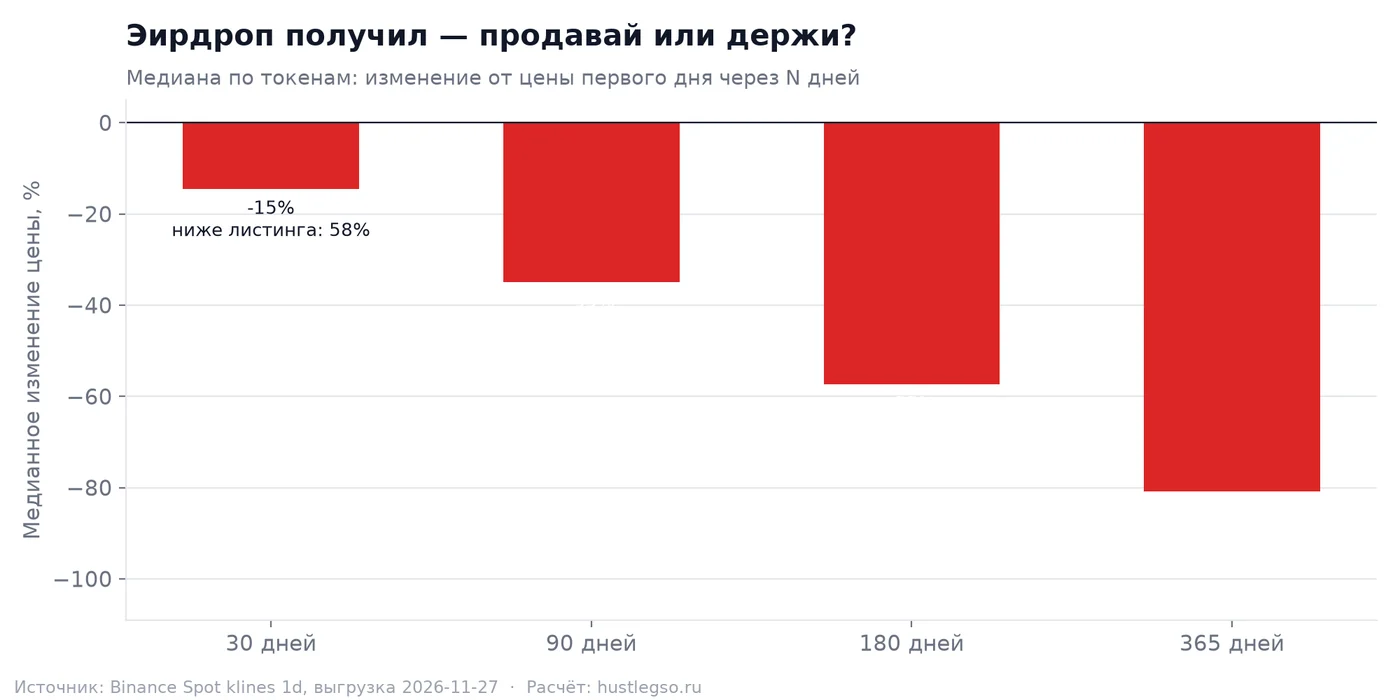
| After | Median price change | Below day one | Down 50%+ | Beat BTC |
|---|---|---|---|---|
| 30 days | −15% | 58% | 13% | 33% |
| 90 days | −35% | 67% | 31% | 16% |
| 180 days | −57% | 82% | 56% | 13% |
| 365 days | −81% | 84% | 78% | 7% |
| Today | −96% | 98% (44 of 45) | 98% | 0% |
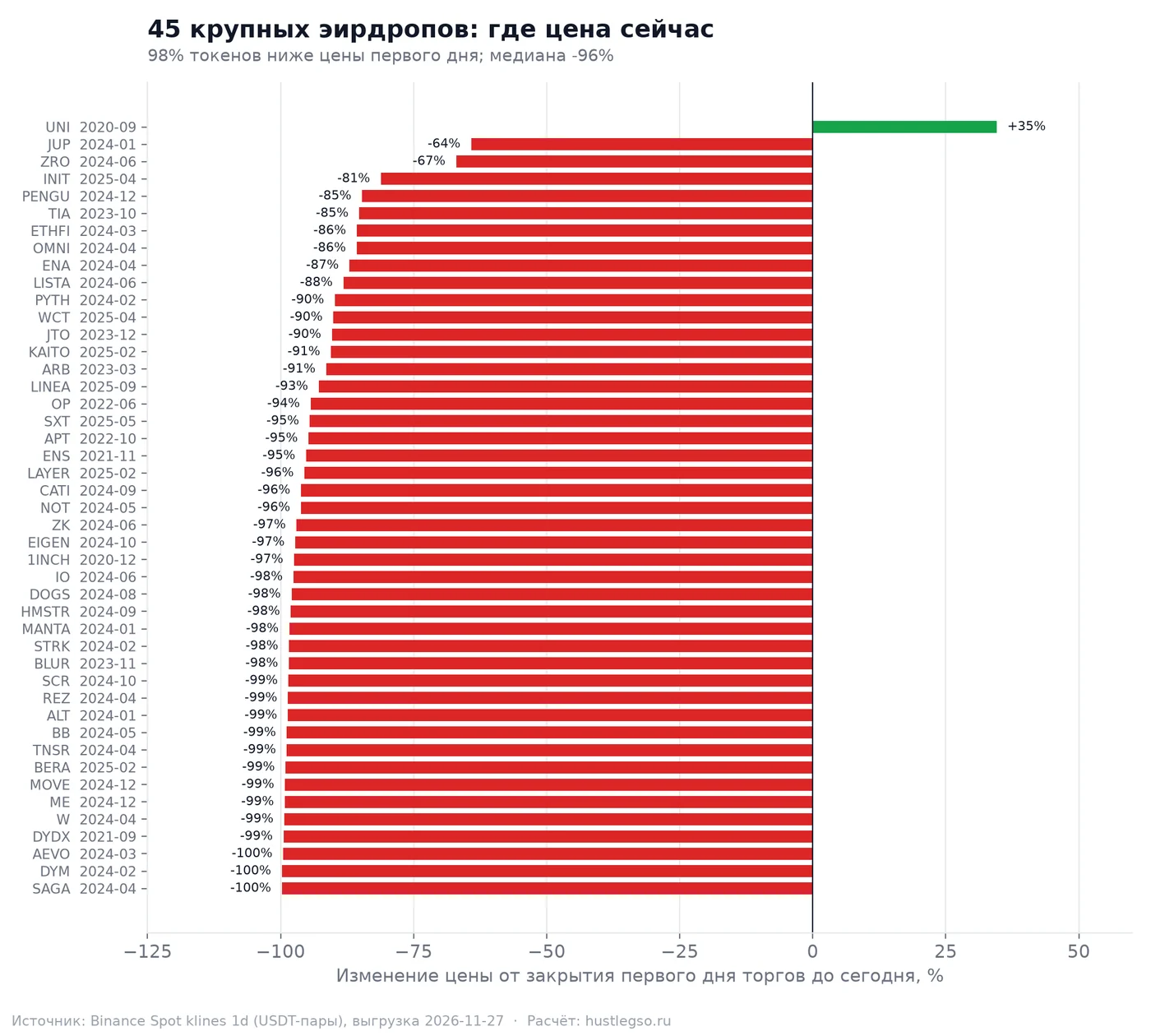
Only UNI, a 2020 drop, is still above its first-day price (+35%). The best of the rest are JUP (−64%) and ZRO (−67%). Not one of the 45 beat Bitcoin over the period to today.
Caveats. The first day on Binance doesn't always match the claim date; someone who sold in the first minutes might have sold higher or lower. The market is falling at the time of the study (BTC −52% from its high). The conclusion holds for this sample.
Why UNI is the exception
UNI was dropped in September 2020, before the 2021 bull market, and Uniswap is a working exchange with real volume and fees. Even so, it lost to Bitcoin: $100 in UNI became $135, the same $100 in BTC became $554. And anyone who held from the peak lost about 90%. You can't reliably repeat that in advance.
The main rule: a drop is a paycheck
On listing day everyone sells at once: farmers who waited months for their money, early investors, market makers. Then team and investor allocations unlock and push the price down further.
Holding a drop means buying that token again every day at the current price. Ask yourself: would I buy it right now with my own money?
The rule. By default I sell everything on day one, in parts throughout the day, on a liquid exchange or DEX, straight into USDT or BTC. If you want to "hold crypto", sell the drop and buy Bitcoin.
When you can keep some
No more than 20–30%, and only if all three conditions hold:
- You'd buy this token with your own money at today's price.
- If what's left drops 90%, it doesn't hurt.
- You wrote down in advance when you'll sell, a date or a price, and you stick to it.
For locked tokens that unlock in tranches, sell each tranche on its unlock day. Write the selling rule before you claim: after the claim, greed always finds arguments.
Where people farm now
Overview as of November 2026; conditions change every month.
- Points and loyalty programs. The project awards points for volume, deposits, referrals. Points may be converted to tokens, or they may not. Nobody knows the rate in advance.
- Testnets. You use the product before launch with test coins. Little money required, lots of time. No reward is guaranteed.
- Telegram tap games. The 2024 boom is over: in our sample NOT is −96%, HMSTR and DOGS −98%. Count your hours and divide the drop by them.
- Staking and restaking with points. Risks: the protocol gets hacked and the coin itself falls. EIGEN −97% and ETHFI −86% to date.
- Exchange programs: Launchpool, HODLer Airdrops, Token Splash, Jumpstart and similar. Easier for beginners, no gas and no drainers, but the amounts are usually small and every platform has different rules. Check conditions only in the exchange's own announcements.
How to farm without draining your wallet
- A separate wallet for activities, with a fresh seed phrase. Your main funds stay in another wallet, ideally a hardware one, and you never connect it to anything.
- A gas budget set in advance, for example $30–50 a month per project. When it's spent, stop.
- 3–5 projects, not 20. Deep, regular usage is rewarded more than one-off transactions almost everywhere.
- Time: realistically 2–4 hours a week for 3–5 projects.
- Clean up token approvals monthly with Revoke.cash.
Sybil filters
A sybil is one person pretending to be many: dozens of wallets doing the same things. They get caught by on-chain traces: funding from one address, identical actions, withdrawals to the same exchange address. Before the ZRO drop in 2024, LayerZero flagged 803,000 addresses as sybils, 13% of roughly 6 million claimants. A wallet farm is a way to get zero on all of them at once.
Drainers and fake claims
Before every big drop, dozens of "Claim your airdrop" sites appear. According to Scam Sniffer, in 2025 such signatures on EVM chains stole about $84 million from 106,000 people.
Take the claim link only from the project's official site or X account, and cross-check the token address on CoinGecko. A normal claim never needs permission to spend your tokens (Approve, Permit, setApprovalForAll): reject it. Don't touch unknown tokens in your wallet that come with a "claim your reward" link.
The farmer's spreadsheet
Without tracking, you don't know whether you earned something or worked for free.
| Field | Example |
|---|---|
| Project / chain | Name, chain |
| Wallet | First and last 4 characters |
| What I do | Swaps once a week |
| Spent on gas, $ | By month |
| Hours | Time spent |
| Points / status | Points, rank |
| Claim | Date, amount |
| Sold, $ | Result |
Profit = sale − gas − fees. Hours go separately. Example: $20 of gas a month × 12 = $240 and 50 hours a year. The drop pays $300 and you sell right away: $60 for 50 hours. Hold it a year and, at our sample's median, you'd have about $57 left, a loss against the gas you spent.
What's next
- Why new coins drop after listing
- Seed phrase: how to write it down and test recovery
- How to take profits
I post warnings about fake claim sites and new airdrop data in my Telegram channel. Follow it if you farm.